
RPGs with Spell Creation Systems: How to Design Freeform Magic Without Breaking the Game
Some tabletop RPGs treat magic as a fixed list. A character learns a spell, reads its description, and casts it when the requirements are met.
That model is comfortable. It is also limited.
Against that model we find RPGs with spell creation systems, where magic is not chosen from a list. It is built. The player does not ask, “What spell do I have?” They ask, “What part of reality do I want to change, and what price am I willing to pay?”
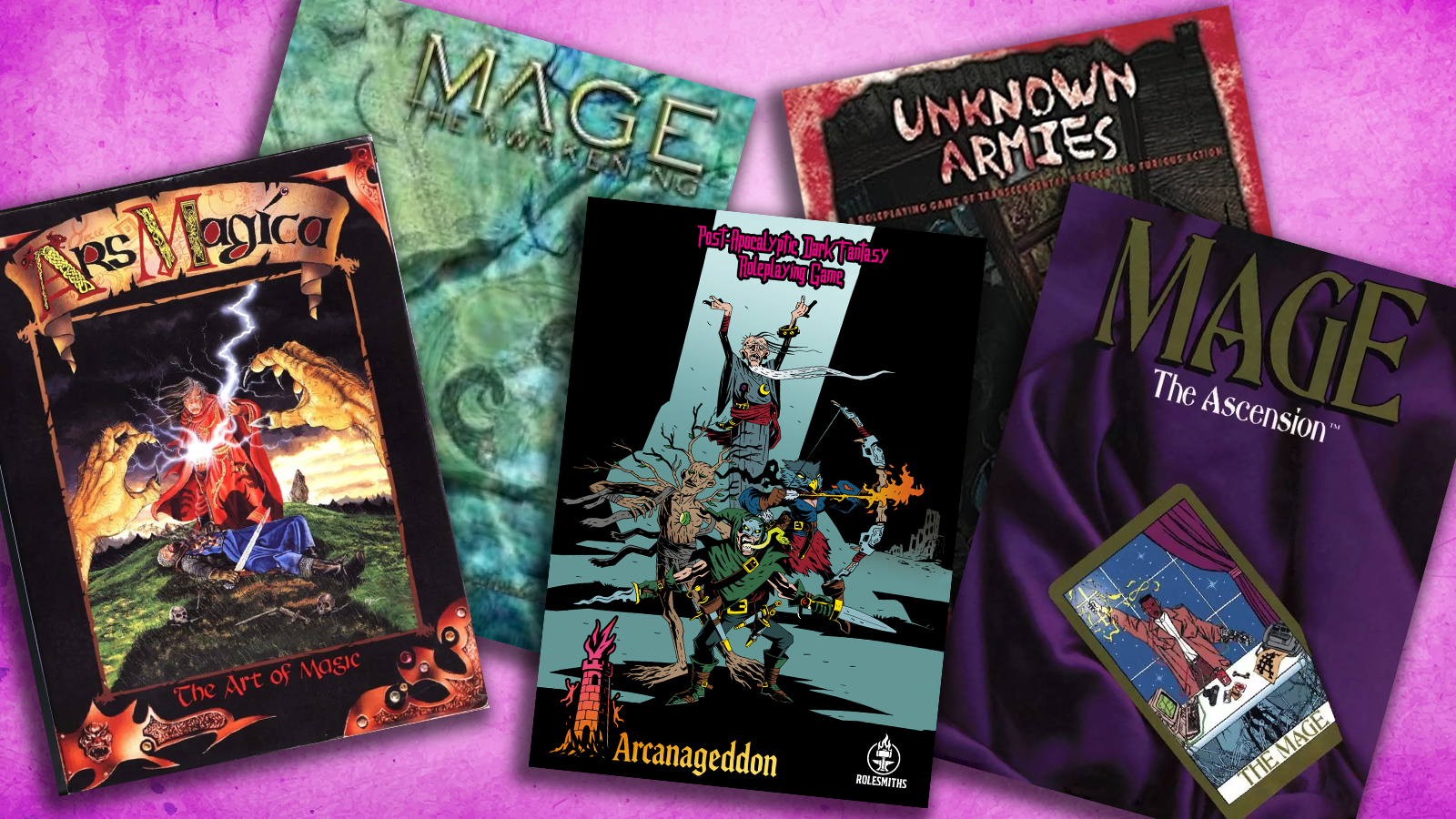
This is where games like Ars Magica, Mage: The Ascension, Mage: The Awakening, Unknown Armies and Arcanageddon come in. All of them understand magic as something more interesting than a catalog of powers. They treat it as a language, a philosophy, or a dangerous way of negotiating with the world.
The key design goal is not to let players “do anything.” That leads to chaos.
The key is to create a system where players can invent spells, but the table can resolve them without arguments.
From Spell Lists to Magical Language
A spell list answers a simple question:
What specific effect can I use?
A spell creation system answers a broader question:
How do I turn a magical intention into a playable rule?
That difference changes the entire experience at the table.
In a closed spell list, the design has already made almost every decision: range, duration, damage, target, cost and limits. The player only decides when to use the spell.
In an open system, the player participates in designing the effect. They decide what they want to change, who or what it affects, how far it reaches, how long it lasts and what consequences it may leave behind.
That allows for much more personal scenes. Two characters may both try to “protect a door” with magic, but one does it by drawing a circle of salt, another by invoking a mathematical law, and another by pressing their own blood into the threshold.
Mechanically, they may seek a similar result. In fiction, they are not casting the same spell.
That is where a good freeform magic system shines.
Ars Magica: Magic as Grammar
Ars Magica is one of the major reference points when discussing spell creation in tabletop RPGs.
Its Hermetic magic system works through a very clear structure: combining an action with a substance. In simple terms, a Technique and a Form. Create fire. Control mind. Transform body. Destroy stone.
This logic turns magic into a grammar.
It is not only about memorizing spells. It is about understanding which magical verb you apply to which part of the world. That is why Ars Magica remains such a strong reference: its magic has structure, but it does not feel closed.
The interesting design lesson here is that creativity does not float in a void. The player can improvise, but always inside a shared language. The table understands what is being attempted because the system forces the spell to be expressed through clear pieces.
That is an essential lesson:
freeform magic needs a shared vocabulary.
Mage: The Ascension: Magic as Belief
Mage: The Ascension takes spell creation in another direction: reality depends on how you understand it.
Its system does not only ask what effect you want to achieve. It also asks which paradigm you use to achieve it. A Hermetic mage, a technomancer, an urban shaman and a chaos mystic may all alter reality in similar ways, but they do not believe they are doing the same thing.
From a design point of view, that matters a lot.
In Mage, magic is not just a tool. It is a statement about how the world works. A character does not cast “telekinesis” for no reason. They may be invoking angelic forces, manipulating gravitational fields, reprogramming a simulation, or convincing the universe that the object was already somewhere else.
The system gains depth because it connects power and belief.
The lesson here is clear:
a spell is more memorable when it reveals who casts it.
Mage: The Awakening: Magic as Procedure
Mage: The Awakening shares part of that DNA, but it offers a more procedural approach. Magic is organized through Arcana, Practices and spell design steps that help translate intention into effect.
This approach is useful for groups that want flexible magic but also need a stronger technical structure. It is not enough to say, “I want to manipulate fate.” The system asks what kind of Practice you are applying, which Arcanum is involved, what level it requires, and which adjustments make the spell stronger or more dangerous.
Its major design contribution is turning improvisation into a guided process.
That reduces the burden on the GM. It also helps players learn what they can do without relying on constant open negotiation.
The lesson here would be:
if a system allows players to invent spells, it must teach them how to invent spells.
Unknown Armies: Magic as Obsession
Unknown Armies approaches magic from another angle. It is less interested in building a universal spell system and more interested in showing that power is born from obsession.
Its magicians are not neutral sages studying an abstract energy. They are broken, intense and contradictory people. Their magic works because they have taken an idea too far.
From a design perspective, this is powerful. The system does not only ask, “What can you do?” It asks, “What have you sacrificed to be able to do it?”
Magic is not separated from psychological damage, identity or the way the character relates to the world. The price is not an extra cost added at the end. It is the center of the system.
The lesson here is one of the most important:
magic becomes more interesting when the price defines the character.
Arcanageddon: Magic as Trace, Risk and Corruption
Arcanageddon belongs to this tradition of RPGs with custom spell creation systems, but it focuses magic through a very specific idea: altering reality always leaves a mark.
In Arcanageddon, a spell should not be just “an effect.” It is a construction with intention, shape, range, duration, intensity, signal and limit.
This changes the conversation at the table.
It is not enough to say:
I cast a spell to control that enemy.
The correct questions are:
What does the spell change?
What does it affect?
How far does it reach?
How long does it last?
What signal does it leave in the world?
What limit does the mage accept for it to work?
That structure gives each spell identity. It also prevents magic from becoming a perfect tool.
Because perfect magic is a design problem.
If it leaves no trace, no one can react.
If it has no limit, the player will always search for the optimal use.
If it has no cost, magic replaces every other decision.
If it has no risk, it stops feeling like magic and becomes invisible technology.
Arcanageddon works best when every spell feels like a dangerous decision, not a power button.
The Key Design Point: A Spell Should Be a Sentence
A good spell creation system needs the player to express their magic as a sentence.
For example:
I reveal the lie that sustains this pact for one scene, inside this room, leaving black smoke over every false word, as long as I have not lied today.
That sentence already contains almost everything needed to play:
- what it does,
- what it affects,
- how long it lasts,
- where it happens,
- how it manifests,
- what condition limits it.
The rule does not need to guess the player’s intention. The intention is written.
This approach avoids one of the biggest problems in freeform magic: endless negotiation. When a spell is defined only by a vague idea, the GM has to decide too much. When it is defined as a structured sentence, the table can resolve it.
That is why spell creation should not begin with numbers. It should begin with language.
First, formulate the magic.
Then, apply the rules.
Five Principles for Designing a Good Spell Creation System
1. Magic Needs Clear Pieces
An open system does not mean a lack of structure.
It needs understandable building blocks: action, target, range, area, duration, intensity, cost and consequence. They may have different names, but they need to exist.
Without those pieces, every spell becomes an exception.
And a system built on exceptions breaks quickly.
2. Limits Should Create Style, Not Just Reduce Power
A limit should not be only a penalty.
“Only works under the full moon” is a limit, but it also creates scenes.
“I can only protect someone who has told me the truth” is a limit, but it also creates drama.
“It cannot cause direct harm” is a limit, but it defines an entire school of magic.
A good limit does not merely say “you cannot.”
It says “you can, but in this way.”
That is where the mage’s style appears.
3. Magic Must Leave a Signal
A signal is the visible, audible, emotional or symbolic trace of the spell.
It may be the smell of ozone, floating geometry, bending shadows, ink under the skin, voices in a dead language or an impossible silence.
The signal serves several design functions:
It makes magic perceptible.
It allows others to react.
It leaves clues.
It creates reputation.
It makes power traceable.
Without a signal, magic becomes too clean. And if magic is clean, it gives the table less to play with.
4. The Cost Must Affect the Fiction
Many systems balance magic through points, spell slots or abstract resources. That can work, but in a narrative magic system it often falls short.
The most interesting cost is not just “lose 1 resource.”
The interesting cost changes the scene, the body, the mind, relationships or the character’s identity.
It can be exhaustion.
It can be corruption.
It can be a debt.
It can be a mark.
It can be damaging the thing that keeps you human.
When the cost affects the fiction, the player does not only calculate whether they can pay. They ask whether they should.
5. The System Must Allow Improvisation Without Forcing the GM to Invent Rules
This is the hardest balance.
If everything is closed, there is no real creation.
If everything is open, the GM carries the entire system in every scene.
The solution is to create procedures.
A good spell creation system does not say “the GM decides.” It says:
Follow these steps.
Define these pieces.
Check these limits.
Apply these consequences.
This way, creativity belongs to the player, but resolution belongs to the system.
Why Many Freeform Magic Systems Fail
Spell creation systems often fail for one of these reasons.
The first is giving too much freedom without a shared language. The player describes something spectacular, but no one knows how to translate it into rules.
The second is using difficulty as the only brake. If everything is solved by raising the difficulty, the system becomes flat. Spells lose identity and only differ by how hard they are to cast.
The third is treating cost as a formality. If the price does not change anything relevant, the player will pay it without thinking.
The fourth is allowing magic with no visible consequences. If no one can detect, trace or fear magic, the world stops responding.
The fifth is forgetting that the mage matters. If every character can cast the same spell in the same way, the system is wasting its greatest opportunity.
Freeform magic is not about doing more things.
It is about doing them in a more personal way.
An Example of a Well-Designed Spell
Imagine a character wants to discover who betrayed the group during a meeting.
A weak version would be:
I cast detect lies.
It works, but it says very little.
A spell designed properly would be:
I reveal the lies spoken in this room during the scene. Each lie appears as black smoke coming out of the speaker’s mouth. The spell only works if I have not lied since dawn.
Now the magic has shape.
It has a verb: reveal.
It has a target: information or emotion.
It has a range: the room.
It has a duration: one scene.
It has a signal: black smoke.
It has a limit: the mage must remain clean of lies.
Most importantly, it has consequences.
If it works, it changes the social scene.
If it fails, it may point to the wrong person.
If it is pushed, it may expose one of the mage’s own lies.
If it leaves a trace, everyone present will know someone used magic on their words.
That is much more playable than a simple “detect lies.”
Arcanageddon and the Central Question of Magical Power
In Arcanageddon, the question should not be:
How much power does my mage have?
The question should be:
What are they willing to lose to change the world?
That is where the system connects spell creation, Corruption, Anchor and Path.
The Path gives coherence to magic.
The Anchor keeps the character tied to the human.
Corruption shows what happens when reality is forced too far.
Limits and signals make every spell leave memory in the world.
This allows magic to be powerful without being free.
A character can create impressive effects, but the system does not let them forget that reality has been wounded. And that wound may look back.
This approach turns every spell into a dramatic decision. It does not only solve problems: it creates new ones.
And that is exactly what makes a magic system memorable.
Conclusion: Freeform Magic Needs Clearer Rules, Not Fewer Rules
The best RPGs with spell creation systems are not the ones that say, “You can do anything.”
They are the ones that say:
You can attempt almost anything, but you must formulate it, limit it and accept its consequences.
Ars Magica teaches the value of magical grammar.
Mage: The Ascension teaches that magic is born from belief.
Mage: The Awakening teaches how to turn improvisation into procedure.
Unknown Armies teaches that power must stain the character.
Arcanageddon brings those lessons into its own direction: magic as creation, cost, trace and deterioration.
A good spell is not just something that happens.
It is a sentence that changes reality.
It is a signal the world can remember.
It is a limit that defines the mage.
It is a dangerous question:
How far are you willing to go?
If you are interested in tabletop RPGs where magic is not a list of powers, but a creative tool with real consequences, Arcanageddon is designed precisely for that: creating spells, breaking limits and discovering what remains of the character after using too much power.
Learn more about Arcanageddon, our tabletop RPG of magic, corruption, and survival.
Frequently Asked Questions About Spell Creation Systems in RPGs
What is a spell creation system in a tabletop RPG?
It is a system where players can build magical effects by combining elements such as action, target, range, duration, cost and consequences. Instead of always choosing fixed spells from a list, they create effects adapted to the scene.
Which RPGs are known for freeform magic?
Some major references are Ars Magica, Mage: The Ascension, Mage: The Awakening, Unknown Armies and Arcanageddon. Each one approaches magic from a different angle: grammar, belief, procedure, obsession or corruption.
Does freeform magic break the game?
It can break the game if it has no clear limits. A good freeform magic system needs structure, visible costs and consequences. Freedom works best when the table shares a common language for creating and resolving spells.
What makes Arcanageddon different from other magic-focused RPGs?
Arcanageddon focuses on the trace magic leaves behind. Every spell has intention, signal, limit and risk. Corruption, Path and Anchor make power more than a tool: they turn it into a progressive transformation of the character.
Is a spell list better than a spell creation system?
It depends on the type of game. Spell lists work well when the goal is speed and closed balance. Spell creation systems work better when the campaign wants personal, dangerous and flexible magic.