


How to Test Your Game System Without Killing the Fun
Designing a tabletop RPG on paper is one thing. Watching it run at the table is something else entirely.
You may have a clear idea, a tidy rules document, and mechanics that look elegant when you read them. Then the session starts. Someone creates a character, someone asks a question you did not expect, one rule takes too long to resolve, and you discover that your system does not live the same way on paper as it does in play.
That is not failure.
That is a playtest.
Playtesting tabletop RPGs is how you find out what works, what players understand, what slows the game down, and which parts of the system are getting in the way of fun. A playtest is not supposed to be a perfect showcase of your game. It is a design tool.
The sooner you accept that, the better your game will become.
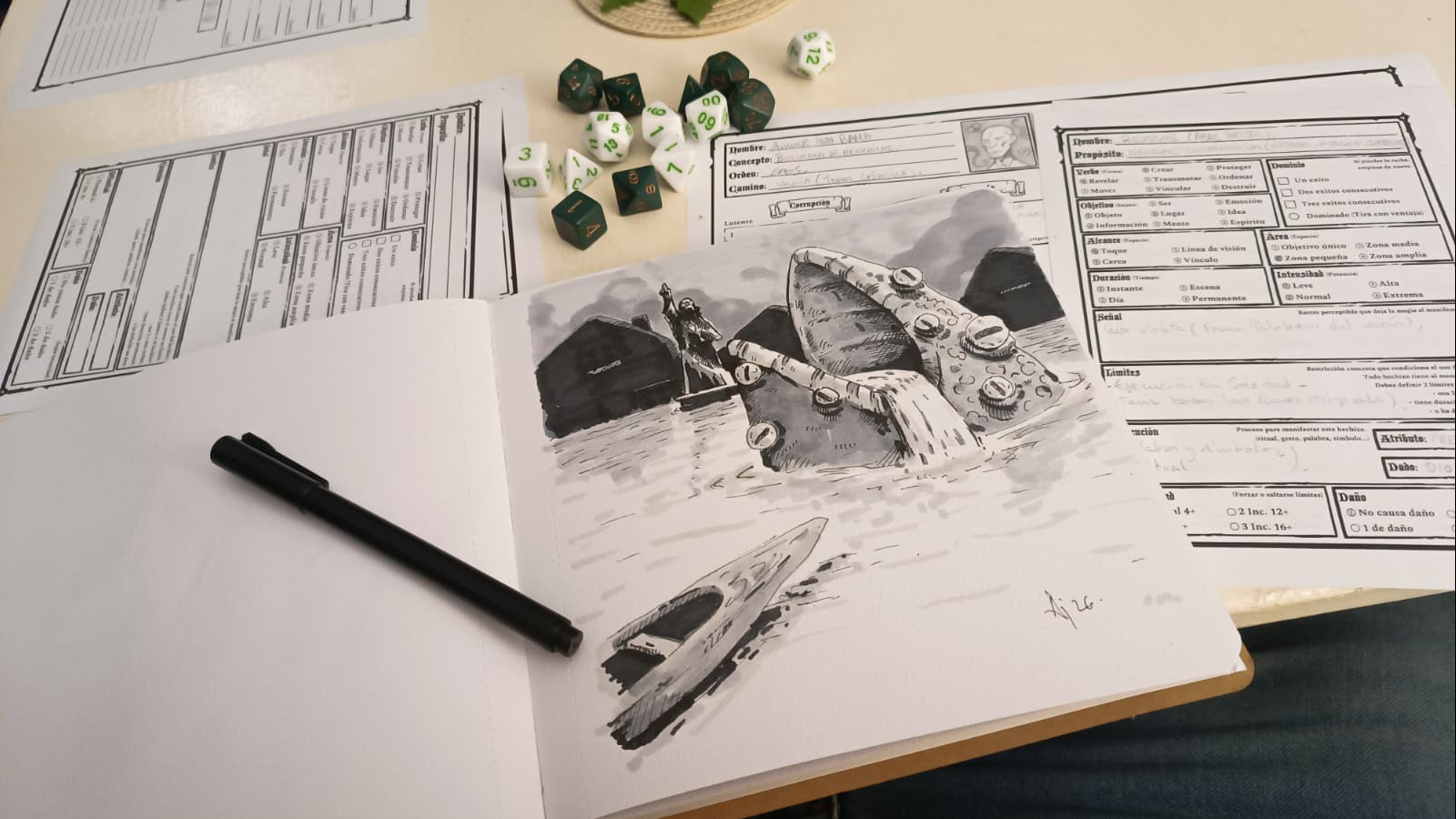
Image: illustration created during an Arcanageddon playtest session by A.J. Heredia, who also contributed to the rulebook’s interior art and color work.
A Playtest Is Not a Normal Session
The first mistake is trying to test everything at once.
When you are playtesting a tabletop RPG, you do not need to run a full campaign, introduce the entire setting, use every rule, and resolve every possible type of scene.
You need to know what you are testing.
For example:
- how long it takes a player to create a character,
- whether the character sheet makes sense without extra explanation,
- whether combat flows,
- whether a damage rule is too slow,
- whether spell creation creates confusion,
- whether the setting’s tone reaches the table,
- whether players understand which decisions matter.
A good playtest has focus.
Do not play “just to see what happens.” Play to answer a specific design question.
Test One Mechanic at a Time
A rule may seem clear until three players try to use it in three different ways.
That is why short sessions focused on a single mechanic are so useful.
If you want to test combat, prepare a conflict scene.
If you want to test character creation, start from zero and track the time.
If you want to test magic, give players a problem that can only be solved by creating a spell.
If you want to test exploration, prepare a small location with clear choices.
You do not need a four-hour adventure.
Sometimes a thirty-minute scene is enough.
In fact, single-scene playtests are extremely useful because they remove noise. You are not testing whether the whole campaign works. You are testing whether one specific rule does its job.
Character Creation Needs Playtesting Too
Many RPGs fail before the adventure even begins.
Character creation may be too long, too abstract, or too dependent on explanations that are not actually written in the rules. If the player needs the designer sitting next to them to understand the character sheet, the text is not ready yet.
A character creation playtest should measure three things.
First, time.
How long does it take someone to create a playable character?
Second, questions.
Which doubts appear again and again?
Third, outcome.
Does the finished character actually fit the kind of game the RPG promises?
In one of our Arcanageddon playtests, we wanted to test exactly that: a fast character creation process, a simple way to create custom spells, and a setting that players could understand during play instead of through a long explanation before the session.
That kind of test is extremely valuable because it shows whether the game can stand on its own.
Adjusting on the Fly Is Not Cheating
During a playtest, a rule may break the rhythm of the session.
It takes too long.
Nobody understands when it applies.
It forces everyone to check three different sections.
It turns an intense scene into paperwork.
When that happens, do not defend the rule.
Write it down and keep playing.
At the table, the priority is that the fun keeps moving. If a rule blocks the session, simplify it in the moment, resolve the scene quickly, and note what went wrong.
The show must go on.
A playtest does not exist to prove that your design was perfect. It exists to find the cracks before publication.
A useful note might be:
This rule slowed the scene down. Revise or remove.
You do not need to fix everything live. You need to detect the problem clearly.
If a Complex Rule Does Not Add Play, Cut It
Designing tabletop RPGs pushes you toward complexity.
You want to cover special cases. You want the system to feel fair. You want every possibility to be accounted for.
But at the table, many complex rules only do one thing: get in the way.
A rule is not better because it has more steps.
It is better if it helps players make interesting decisions.
If a mechanic requires a long explanation and does not make the scene more fun, more tense, or clearer, it probably needs to be simplified.
Sometimes the best adjustment is not adding an exception.
It is deleting half a page.
This matters especially in games with magic, damage, corruption, character creation, or extended conflicts. These are areas where a rule can look elegant on paper and feel heavy in play.
The table does not forgive excess.
Listen to Player Questions
Player questions are data.
When a player asks, “Can I do this?”, they are not interrupting your design. They are pointing at a gap.
When someone says, “I do not know what to choose,” maybe the option is not clear enough.
When the same rule gets asked about twice, maybe it is in the wrong place.
When everyone looks at the GM before acting, maybe the system is not giving players enough autonomy.
During a playtest, do not argue with every doubt. Write it down.
After the session, look for patterns:
- repeated questions,
- concepts nobody uses,
- rules everyone forgets,
- choices nobody cares about,
- moments where the table’s energy drops.
That is where the real design report is.
Test With Different Groups
A trusted group is perfect for early tests. But it is not enough.
Your friends already understand how you GM. They know your taste. They may fill in gaps without realizing it. Sometimes the game works because they know you, not because the rules are clear.
That is why you need different groups.
Veteran players spot system holes.
New players spot clarity problems.
Other GMs reveal whether the manual can run without you.
Narrative groups and tactical groups stress different parts of the design.
If a rule only works when you are the one running it, the rule does not fully work yet.
How to Organize Playtest Notes
You do not need a huge document. You need notes you can actually use.
A simple structure works:
Date:
Group:
Duration:
What we wanted to test:
What worked:
What was slow:
What caused questions:
Which rule was ignored:
Which rule had to be improvised:
What was the most fun:
What needs to change:
Add a section for direct player quotes.
Player quotes:
- “I do not understand when this applies.”
- “This is cool, but it takes too long.”
- “I did not know what I was allowed to do here.”
- “This cost actually made me think twice.”
Real quotes are more useful than polished summaries. They show the problem exactly as it appeared at the table.
Example: Testing a Specific Scene in Arcanageddon
In the Brumavieja playtest, the goal was not to show all of Arcanageddon.
The goal was to test a few specific things.
First, whether players could quickly enter the tone: rain, mud, corruption, a drowning village, and a well that does not behave as it should.
Second, whether they could create characters who fit that world without long preparation.
Third, whether the spell creation system let players build their own magic without stopping the session for half an hour.
Fourth, whether a conflict scene could resolve with tension, consequences, and pace.
That approach turns the session into a useful test. You are not asking, “Was the session good?” You are asking something more precise:
Was character creation fast?
Did the magic system make sense?
Did the setting reach the table?
Did the rules help the scene or slow it down?
Those answers are what improve a prototype.
The Session May Be a Mess, and That Is Fine
There is always a gap between your rules draft and a real table.
Sometimes the first test goes badly.
Sometimes a central rule does not work.
Sometimes players do not understand what seemed obvious.
Sometimes the scene that was supposed to be spectacular becomes slow.
That hurts, but it is useful.
A messy playtest is much better than a messy published game.
Every problem you detect is an opportunity to cut, clarify, or simplify. The goal is not to prove you were right. The goal is to discover what the game needs in order to work without you.
Conclusion: Test Fewer Things, But Test Them Better
Playtesting a tabletop RPG is not about playing a lot without a method.
It is about preparing sessions with intent, watching the table, and accepting that design changes when it meets dice, voices, doubts, and real decisions.
Run small tests.
Listen to players.
Write down what slows the game.
Simplify without fear.
Test with different groups.
Do not fall in love with a rule that does not create fun.
A good playtest is not the one that goes perfectly.
It is the one that teaches you what the game needs in order to become better.
In Arcanageddon, many design decisions come from that idea: magic should be quick to create, costs should be felt at the table, and every rule should push the game toward tension, deterioration, and spectacle. <p><strong>Learn more about <a href=https://rolesmiths.com/en/arcanageddon/>Arcanageddon, our tabletop RPG of magic, corruption, and survival</a>.</strong></p>
Frequently Asked Questions About Playtesting Tabletop RPGs
When should I start playtesting my tabletop RPG?
Start when you have a minimum playable version. You do not need a complete rulebook. You need characters, a clear situation, and the rules required to test what you want to check.
How long should a playtest session be?
It can be a full session, but it does not have to be. A 30- or 45-minute scene can be enough to test combat, spell creation, exploration, or one specific rule.
What should I do if a rule fails during the session?
Resolve the scene in the simplest possible way, write down the problem, and keep playing. Do not turn the playtest into a design debate. Review the rule after the session.
Is it better to playtest with friends or strangers?
Start with friends to catch major problems. Then test with other groups to see whether the system is clear without you filling in the gaps. Both types of playtest are useful.